

Written by Matt Morgan at The Daily Bell:
You already trust order without a ruler in the highest-stakes relationships on Earth. You do it every day without noticing, and…
You only lose your nerve when the missing ruler is the one over your own street.
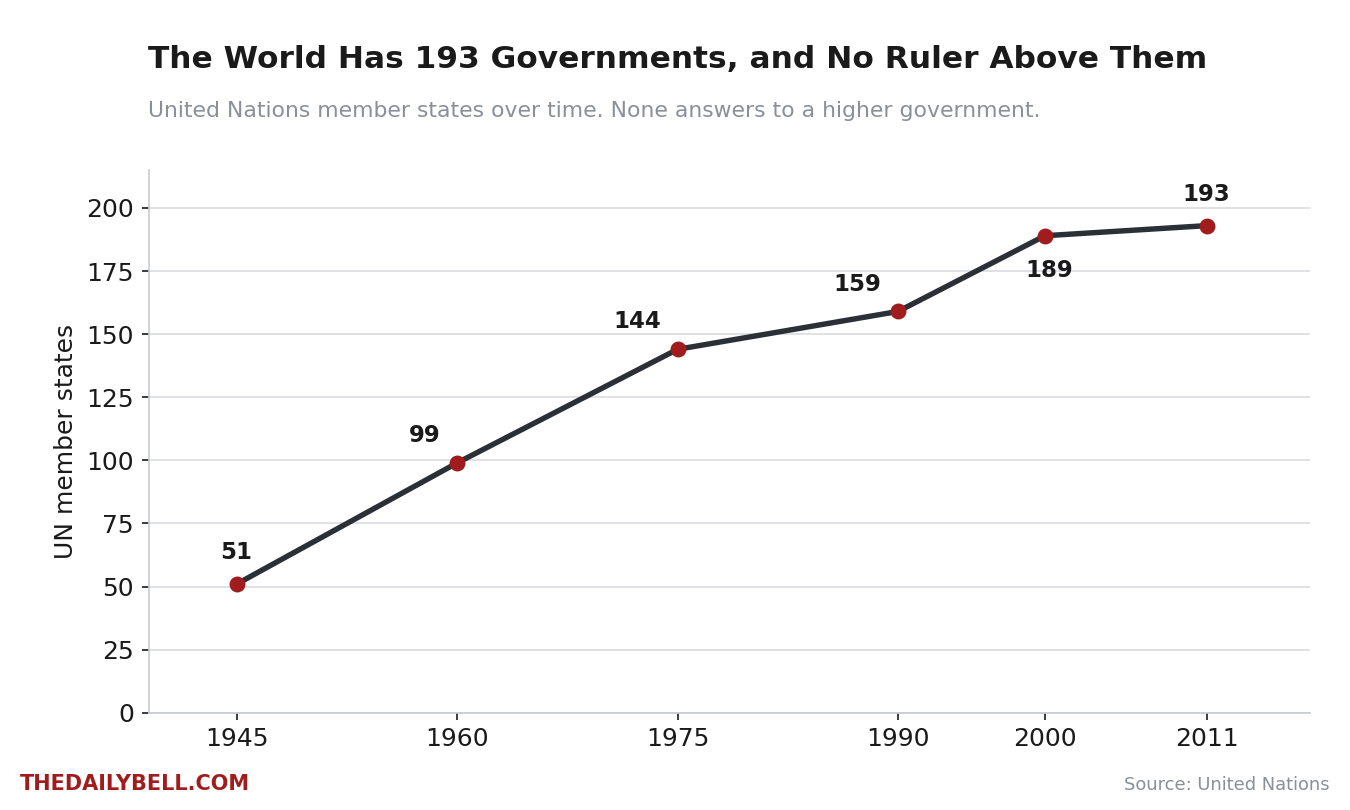
Start with a fact so plain it is easy to miss. There is no world government. No global police force can arrest a country. No planet-wide court can force one to obey against its will. Today there are 193 governments recognized at the United Nations, and not one of them answers to a higher one. Each is sovereign, which means it takes orders from no one above it.
By the popular definition of anarchy, the one that means no ruler at the top, the entire world of nations is in a permanent state of anarchy. There has never been a ruler over all of them, and there is none now. In fact, after World War II more nations peacefully divided without large scale war.
Now look at what that anarchy produces. Not the constant war you might expect.
Take the border between the United States and Canada. It is the longest undefended border in the world, thousands of miles long, and no army guards it. The two countries have been at peace since the War of 1812. No world government keeps that peace. No global sheriff patrols the line. Yet more than 2.5 billion dollars in goods and services cross it every single day, on nothing more than contracts, habit, and shared interest.
Most borders are quiet most of the time. Nations sign treaties and keep them, and no global power forces them to. They trade, lend, and settle the large majority of their quarrels with no armed ruler over them. Order at the highest level runs on agreement, not on a boss.
So here is what you have already accepted: that nearly 200 governments can live side by side, trade, and mostly keep the peace with no ruler above them. Almost no one finds that strange. It gets taught as simple geography.
Here’s where we ask a good question from the anarcho-capitalist perspective:
If the missing ruler does not cause chaos between 200 governments, why would it cause chaos between 200 million people? And, what is the difference in principle between nations that keep the peace without a world state, and neighbors who keep it without a national one?
The common reply is that nations have armies to defend themselves, while individuals would be helpless without a single police force above them.
If you believe that then look again at what you just granted. The peace between the United States and Canada does not hold because a higher power forces it. It holds because war is expensive and trade pays better, and both sides know it. The same forces that keep two governments out of each other’s throats, self-interest, reputation, and the plain cost of fighting, work between people too. It is the logic behind every deal you have ever made with someone you could not command and could not report to the world police.
The condition we describe (from the anarcho-capitalist), order among equals with no ruler above them, is not some far-off experiment. It is the normal condition of the most important relationships on the planet, and they mostly hold.
You are not being asked to picture something strange or new. You already live by this rule where the stakes are highest, between whole nations, armed and proud and answerable to no one above them.
You only flinch when the same rule is turned on your own block. So ask yourself why the trust you extend to two hundred governments runs out at your own front door.