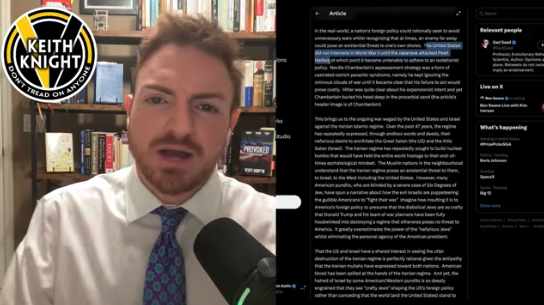
Keith Knight rebuts a viral X claim that “the United States did not intervene in World War II until the Japanese attacked Pearl Harbor” by walking through multiple documented acts of US intervention preceding December 7, 1941, including the destroyers-for-bases deal, Lend-Lease, the September 11, 1941 shoot-on-sight order against German submarines, the Atlantic Charter’s commitment to destroying Nazi tyranny, Lend-Lease extension to the Soviet Union two days after the German invasion, and the July 1941 freezing of Japanese assets. He cites Secretary of War Henry Stimson’s diary entry from November 25, 1941 in which Roosevelt openly discussed how to “maneuver them into the position of firing the first shot without allowing too much danger to ourselves.” Knight argues the troop movement from California to Hawaii (not yet a state until 1959) was part of a deliberate provocation strategy to justify entering the war alongside Churchill against National Socialism, making the standard isolationist narrative factually indefensible.
Top 5 Key Topics
The Stimson diary smoking gun: Henry Stimson’s November 25, 1941 diary entry records Roosevelt bringing up Japanese relations and stating attack was likely “perhaps as soon as next Monday,” with the discussion explicitly framed as “how we should maneuver them into the position of firing the first shot without allowing too much danger to ourselves.” Knight argues these are not the words of an isolationist administration sitting on its hands.
The shoot-on-sight order of September 11, 1941: Three months before Pearl Harbor, Roosevelt ordered the US Navy to fire on any German submarine, which Knight frames as direct kinetic intervention in the European war. This sat alongside the extension of the US patrol zone to longitude 26 (defending Iceland) and the destroyers-for-bases deal transferring 50 warships to Britain.
Lend-Lease as material intervention: The Lend-Lease Act explicitly armed the British to kill Germans, and within two days of Hitler’s invasion of the Soviet Union, Roosevelt extended Lend-Lease aid to the USSR as well. Knight draws an explicit parallel to Ukraine, asking whether arming one side and publicly declaring allegiance to it would today count as non-intervention.
The Atlantic Charter of August 1941: Churchill himself expressed shock that the Americans would commit in writing to the destruction of Nazi tyranny, which Knight presents as an open declaration of war aims four months before Pearl Harbor. The charter listed the destruction of Nazi tyranny as one of its formal points.
Japanese asset freeze as provocation: The July 1941 freezing of Japanese assets combined with troop relocation from California to the Hawaiian Islands (Hawaii not becoming a state until 1959) was designed to move forces closer to Japan to invite an attack. Knight frames this as part of a coordinated provocation strategy aimed at getting Axis powers to fire first so Roosevelt could join Churchill’s crusade against National Socialism.