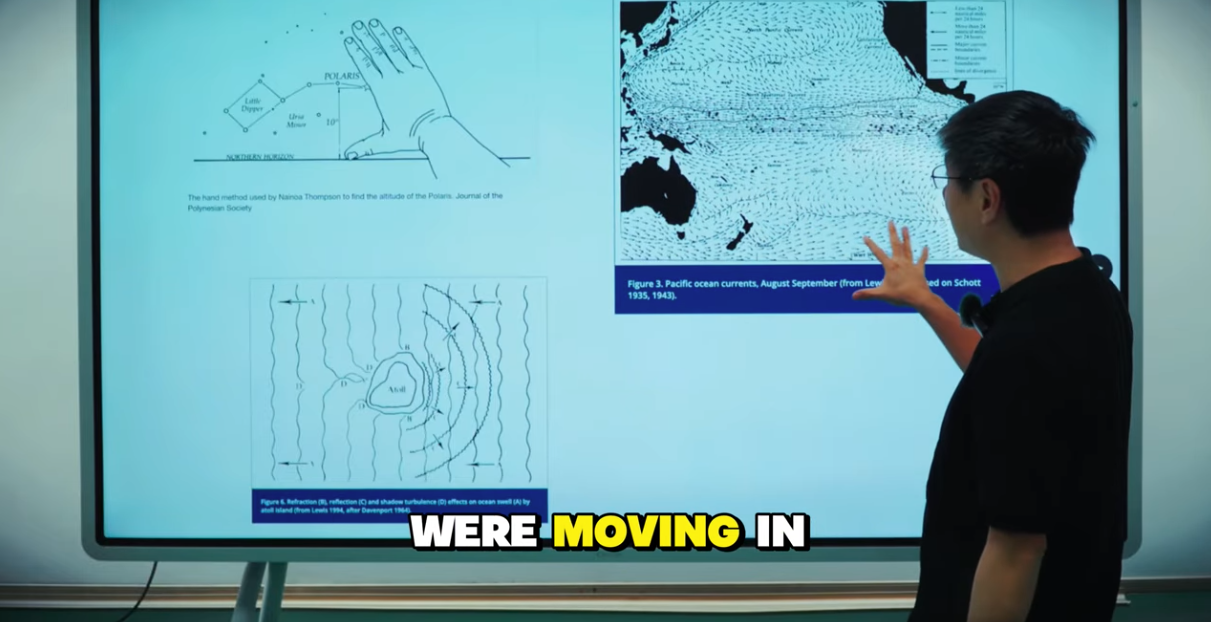
The lecturer argues that ancient peoples were not less intelligent than moderns but possessed a stronger “imagination” that let Polynesians navigate the entire Pacific by memorizing stars, currents, and winds without sleep, and let Egyptians build the pyramids “from the inside out” in their heads without blueprints or computers. He claims the pyramids were a temple and public works project rather than a tomb, that calling Egyptian achievement alien-built is “a racist comment,” and that humans did not evolve from apes mentally because “our minds come from somewhere else”—a myth he says exists to justify power hierarchies. He contends modern work produces inferior results because it replaced religious devotion and shared vision with top-down, process-oriented management focused on doing the least work for the most pay, which is “why everything we do today is just crappy.”
Top 5 Key Topics
Polynesian navigation as proof of imagination: The lecturer says Polynesians settled every island in the Pacific using small boats, mapping stars and oceanic currents entirely in their heads and staying awake throughout, because a navigator who fell asleep got lost and died. He insists a computer would not save a modern person dropped in the Pacific, dismissing a student’s point that computers offer more precise information.
Pyramids as temple, not tomb: He rejects the school-taught claim that the pyramids were tombs for a god-pharaoh, calling that “insulting,” and reframes them as a temple and a public works project alongside canals. He says the 20-year build required empathy and a vision so compelling that everyone knew their part, “almost like telepathy.”
Rejection of human evolution from apes: He presents “we evolved from apes” as a myth, conceding bodies may have but asserting minds did not, and claims this teaching exists “to justify the power hierarchy”—the idea that those in charge are simply stronger and more fit.
Religious devotion versus modern process management: He contrasts ancient workers motivated by bringing “heaven to earth” and prosperity for descendants against today’s “make more money” mindset and top-down process management. Using the school essay sequence (plan, outline, draft, iteration) as an example, he argues breaking work into a process produces worse results because it loses the unifying vision.
Surviving examples and the Manhattan Project: He cites the Hagia Sophia (532), Aachen Cathedral (1790, burial site of Charlemagne, “first Holy Roman Emperor”), and the pyramids as still-standing proof of care driven by spiritual purpose. He calls the Manhattan Project—100,000 scientists building the atomic bomb—the greatest human achievement of the 20th century, crediting belief in creating “eternal peace” and arguing the bomb made nations afraid to wage devastating war.