

Written by Matt Morgan at The Daily Bell:
Before governments took over the job of caring for people, ordinary working families did it themselves. Not through charity, and not alone, but through societies they built, paid for, and ran. The state did not come along and do it better. It pushed those societies aside and took their place.
For about a century, the center of working-class security in America was the fraternal lodge. These were member-run clubs with names like the Odd Fellows, the Moose, and the Eagles, and they were far more than places to socialize. For a small regular payment, a member and his family got real protection: sick pay, life insurance, a doctor, and help burying the dead. Some lodges built orphanages, hospitals, and homes for the elderly, which is very much like what the veteran affairs does in partnership with Legion organizations today.
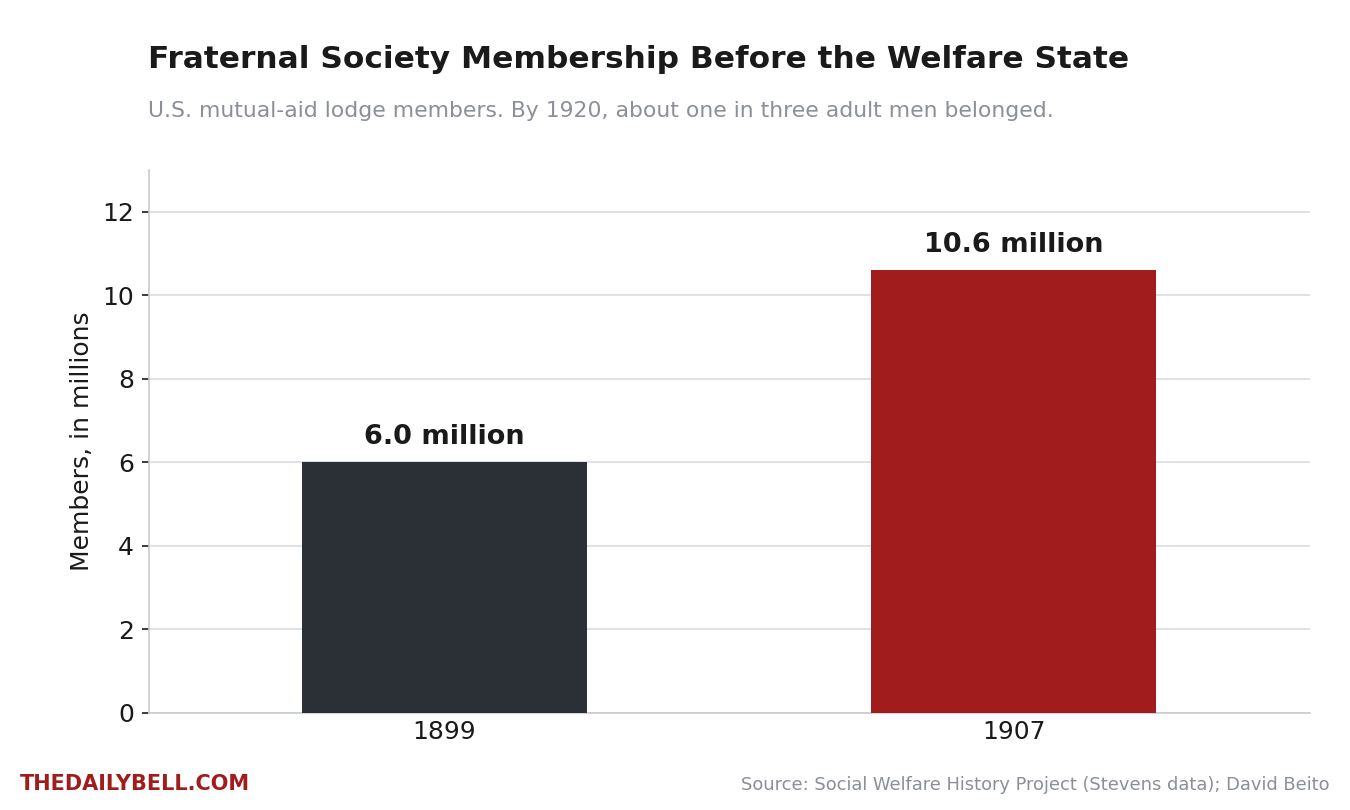
In 1899, roughly six million Americans belonged to these societies. By 1907 the number had passed ten million. By 1920, the historian David Beito estimates, about one in three adult men belonged to at least one, and that does not count the women and children in the groups tied to them.
What mattered was how it felt to the people who used it. This was not a rich man handing coins to a poor one. Members paid dues, elected their own officers, and voted on how the money was spent. When a member fell sick, the help he got was something he had paid into and helped run, not a favor from above. There was no means test, no caseworker, and no shame in taking it.
One service stood out. A lodge would hire a doctor for a yearly fee, and every member got care for a few dollars a year. It worked so well that it drove down the price of medical care for ordinary people, which is what got it into trouble.
The lodges did not fade on their own. They were pushed.
Doctors’ groups hated lodge medicine because it cut their fees. Medical associations refused to admit lodge doctors, leaned on hospitals to turn lodge patients away, and pressed the states to make a medical license harder to get, which shrank the supply of doctors and raised the price of care. Then the welfare state arrived and took over the very services the lodges had pioneered. Scholars list the rise of the welfare state, insurance rules, and new competition as the reasons the societies fell into a decline they never recovered from.
The lodge leaders saw it coming. As early as 1915, the Fraternal Order of Eagles warned that the state now planned to do for the worker what the lodge had done for years. They were right, and it finished them. I’m not trying to make the point that we need these kind of societies, or that they were good. The point is that people can and do voluntarily organize themselves for the welfare of the community.
The usual case for the welfare state is that markets are cold, and only the government will care for people who cannot pay. But the record shows the reverse. The personal, neighborly system already existed, built by the people who used it, and the state did not join it. The state replaced it.
Something real was lost in the trade. A lodge tied help to membership in a community. It came with faces, meetings, and a say in how the money was spent. What replaced it was a check from an office, run by strangers, that asks nothing of you and offers no seat at the table. Aid went from something you belonged to into something you apply for.
We were told the state had to care for us because no one else would. To make that true, it first had to clear away the people who already did.