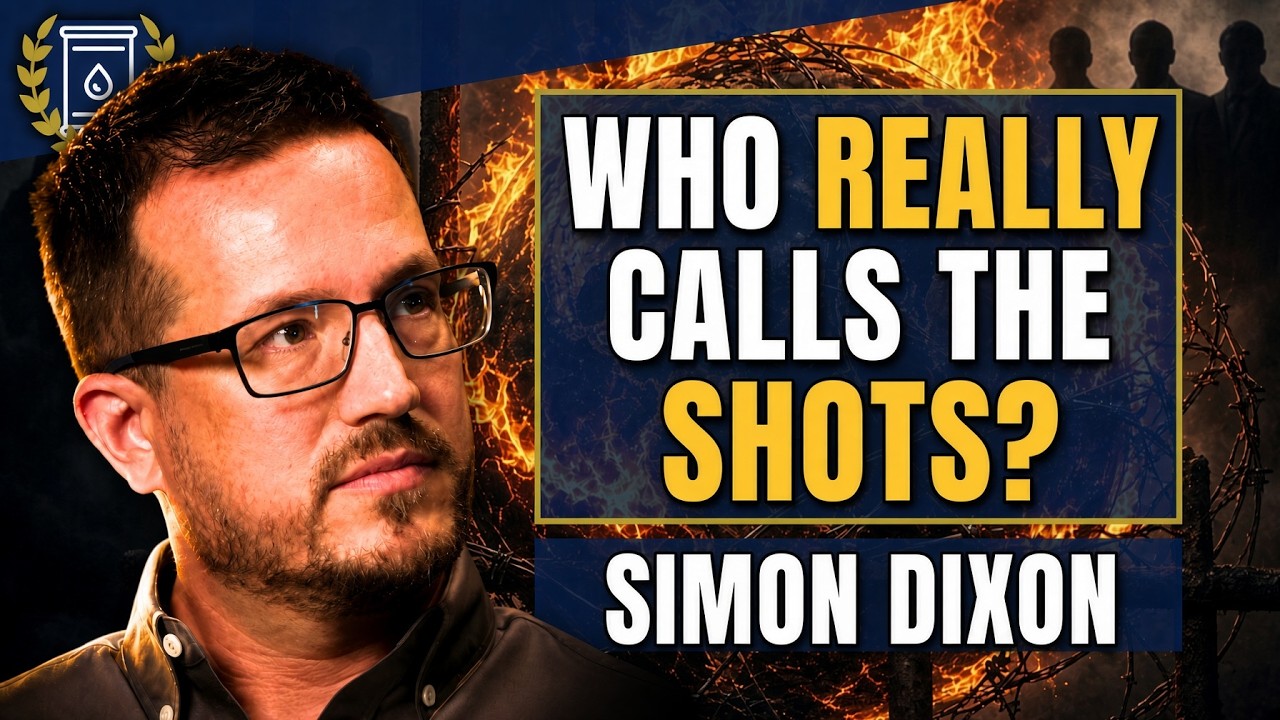
Dixon argues that geopolitics is controlled not by governments but by three interlocking complexes: the financial-industrial complex (BlackRock, JP Morgan, major banks), the military-industrial complex (Lockheed Martin, BAE Systems), and the technical-industrial complex (Google, Meta, Palantir), which together control capital, military force, and narrative. He contends that all wars are resource grabs disguised by propaganda, with a business model mixing forever wars (Afghanistan’s 20-year, $2 trillion cycle), aggressive conflicts, and defense subscription contracts, and that politicians are selected for blackmail-ability and lobby service rather than elected to serve voters. Dixon concludes that Europe is being deliberately destabilized through immigration, energy crises (Nord Stream sabotage), and civil unrest to justify a technocratic control grid of AI, central bank digital currencies, and surveillance, while every crisis concentrates wealth upward into fewer hands via debt, asset stripping, and stock market privatization of gains.
Top 5 Key Topics
Media as propaganda tool: Dixon states that all media is propaganda, whether alternative or traditional, funded by sponsors and infiltrated by intelligence agencies pushing narratives. He asks not whether a story is true but who wants him to believe it, then follows the money through shareholders and affiliations to identify the real agenda behind any headline.
The three ruling complexes: Dixon identifies the financial-industrial complex (investment banks, BlackRock, State Street), the military-industrial complex (Lockheed Martin, General Dynamics, BAE Systems), and the technical-industrial complex (Google, Meta, SpaceX, Palantir) as the mafia-like power structures that control capital, military force, and data. He explains that Western governments are subordinate to corporate power, unlike China where corporations serve the state, and that these complexes select and promote individuals who serve their interests through blackmail and lobby funding.
War as a business model: Dixon describes a portfolio approach to war: forever wars like Afghanistan (20 years, $2 trillion, replacing the Taliban with the Taliban), aggressive resource-grab wars, and defense subscription contracts that function as protection rackets. He argues that all war narratives about democracy, religion, or human rights are cover stories for controlling strategic choke points, energy, and financial transactions, with finance profiting from both the destruction and the rebuild.
Europe’s engineered destabilization: Dixon claims Europe is the next profit center after the Middle East forever war winds down, with civil unrest manufactured through immigration, the Nord Stream pipeline sabotage, deindustrialization, and algorithm-driven radicalization to justify a police and surveillance state. He says the pension crisis, aging population, and 100 percent debt-to-GDP ratios are being weaponized to subordinate European governments to bondholders and private equity, with leaders like Keir Starmer and Macron serving financial power while pretending to serve the people.
Investment strategy in a rigged system: Dixon recommends owning hard assets (gold, Bitcoin, silver) as savings to outperform inflation, holding stocks and bonds to benefit from the war machine and bailouts, and recognizing that the stock market will always be rescued because gains are privatized while losses are socialized through government debt. He sees a shift to a multipolar world with regional blocs (BRICS, ASEAN) and believes decentralization (self-custody of gold and Bitcoin, running your own AI models) is the resistance strategy against centralizing tech, finance, and military power.