“Is Killing” might be more appropriate than “Killed”. But in the larger context of history, how do you refer to something that has lost more than 99% of its value? The US Dollar, as measured against real money, i.e., gold, has indeed lost more than 99% of its purchasing power since 1971.
Only in the context of academic circles with non-Austrian Economists or when measured against other fiat currencies would the dollar be considered “strong”. Even against other good currencies, the US Dollar has lost substantial purchasing power since 1971, e.g., more than 80% against the Swiss Franc and more than 50% against the Japanese Yen. In any case, it is only a matter of a few more years before the impending demise of the US Dollar becomes obvious to everybody, and the phrase “Not worth a Continental” becomes almost as applicable to the US Dollar.
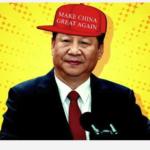
Let me start with the answer to the title – it is Paul Samuelson, and this should be no surprise to the regular reader of my columns. While I have used names, I am really referring to the Chinese Juggernaut Economy (for Xi Jinping), and Neo-Keynesian Economics (for Paul Samuelson), and the names are really proxies for the institutions/ideas they represent.
Most readers may not be aware that Neo-Keynesian economics gained traction only since the 1960’s, when the idea that “a little deficit spending” may smooth out the business cycle. Till such time, balanced budgets were the norm, and in fact, the US Government ran a surplus for a few years during the 1950’s when it paid down the National debt. For example, the US National debt witnessed a modest decline during 1952, 1956, and 1957.
For the decade as a whole, between 1950 and 1960, the US National debt witnessed a 11% increase, compared with the nearly 30% increase between 1960 and 1970. Not coincidentally, Paul Samuelson served as an economic advisor to John F. Kennedy (1961-63) when this line of thought germinated in the US administration. Those “little deficits” that Paul Samuelson intellectually justified were the proverbial camel’s nose under the tent. The shift from “a little deficit spending is good” to “deficits do not matter” was entirely foreseeable under democratic politics. The Neo-Keynesian economists continue to give it the necessary intellectual cover, albeit a terribly flawed one.
What is the Neo-Keynesian Ideology?
This is the most pervasive economic ideology that is taught in most Universities (perhaps more than 99%) across the world. Two other Economic Schools of thought – Marxism and the Chicago School / Monetarists – are either discredited entirely (Marxism), or reluctantly embraced Keynesian Economics (“We are all Keynesians now” – Milton Friedman, 1965). The latter, perhaps, resulted from two factors: a lack of grounding in sound economic principles and the fear of becoming irrelevant in a domain dominated by the state.
The one little-heard-of and even less discussed school of thought in the media that has stood its ground against Neo-Keynesian economics is the Austrian School of Economics. It is best to define the framework of the Austrian School of Economics before we venture into Neo-Keynesian economics. It is just easier to understand the con when the truth is clear. We will describe both these schools of thought in terms of the four operating tenets of the State: Money, Scope of Government, Role in Economic Growth, and Role in a Recession.
Defining Tenets of the Austrian School of Economics
The US Government, right from its founding days until 1913, and perhaps in a more limited way till 1971, operated under the above tenets. The Founding Fathers were Libertarians (the political philosophy equivalent to the Austrian School of Economics) and subscribed to the tenets of limited government and sound money.
Having understood the basic tenets of the Austrian School, let us now look at the Neo-Keynesian Ideology.
There is no middle ground between these two schools of thought, and only one can be correct. Is it the Austrian school that enabled the US transition itself from a primitive agrarian economy into an unrivalled superpower under the tenets of a limited government and sound money that the founding fathers envisioned for the US? OR is it the Neo-Keynesian ideology that has seen the US dollar lose more than 99% of its purchasing power in 55 years and has made the US the largest debtor nation in the history of the planet with the currency on the verge of a historic collapse?
I think the question answers itself, but to the sceptical mind, patience for a few more years would provide the irrefutable evidence.
Just one additional clarification, before we turn to China. If the Neo-Keynesian model is so flawed, how did the US economy survive for more than half a century operating under this framework? Two reasons:
Neo-Keynesian economics creates the illusion that it works under conditions of falling interest rates, as it indeed has been the case for more than 40 years, from 1981 to 2022. Under conditions of falling interest rates, monetary inflation masquerades as growth, and we will see the real impact of deficits and debt only when the interest rate cycle’s upswing, which started in 2022, takes a firm hold. Or to paraphrase Buffett, “Only when the interest rates go up do you discover who’s been swimming naked.” In the years ahead, the famed American consumer stands to be exposed starkly.
The Emergence of China
China began its structural reforms in 1990, and at that point, the US economy was 16 times China’s GDP ($5.96 trillion vs $360 billion). Today, the US economy is barely 50% bigger than China’s ($31 trillion vs $20 trillion). While China grew from a much smaller base and hence could grow faster, what is alarming is the US trade deficit, which has persisted over the decades.
The US reported a trade deficit of $900 billion in 2025 while China had a trade surplus of $1.2 trillion. What this really indicates is that the Chinese RMB needs to strengthen, especially against the USD, and that this change alone could help China become the world’s largest economy, surpassing the US. It is only a matter of time; this outcome is inevitable, though not imminent. The picture below captures the shift in trading patterns between the US and China worldwide this century.

There is no point in blaming Xi Jinping; China merely occupied the manufacturing space that the US willingly vacated. The primary reason is the ultraloose monetary policy the US has had since the turn of the century, and, more generally, the transition away from Free Market Economics toward the Neo-Keynesian ideology since 1971. This degradation has only gathered momentum in the last 25 years, and we are in the last stages of the economic cycle- or what Mises would refer to as the “Crack Up Boom”.
The Likely Way Forward
Given the current geopolitics, and this is very likely to continue, most analysts would blame the higher consumer prices in the years ahead on the wars. While it is certainly true that there is increased monetary inflation in times of war, decades of accumulated monetary inflation have barely begun to spill over into consumer prices.
Wars or otherwise, we are certainly going to have much higher price inflation and interest rates in the years ahead. These geopolitical events give politicians a very convenient excuse to explain away the plummeting purchasing power of currencies by attributing it to exogenous events such as wars rather than to their own deficits and debt. In 2025, when the DXY fell 10%, even CNBC was talking about de-dollarization, National debt, unfunded liabilities, and the twin deficits. Today, the talk is about Greenland, Iran, and Venezuela.
Inasmuch as wars lead to higher gold prices, it could be legitimately argued that rising gold prices (due to governments’ fundamental currency debasement) fuel geopolitical tensions, allowing governments to explain away their own economic mismanagement. To that extent, we can expect more wars, more instances of the US seeking to bring democracy to other countries, or attempts at regime change in nations with abundant natural resources.
The only hope for the rest of the world is the precarious state of the US dollar. The US can continue this at best for another couple of years before a collapsing currency brings an end to its meddling in the internal affairs of other nations. As far as US citizens are concerned, salvation truly lies within. The solution to their oncoming economic woes must be a return to the foundational principles of limited government and the Gold Standard.
About the Author
Shanmuganathan N (aka Shan) is an Economist based in India and can be contacted at shan@plus43capital.com