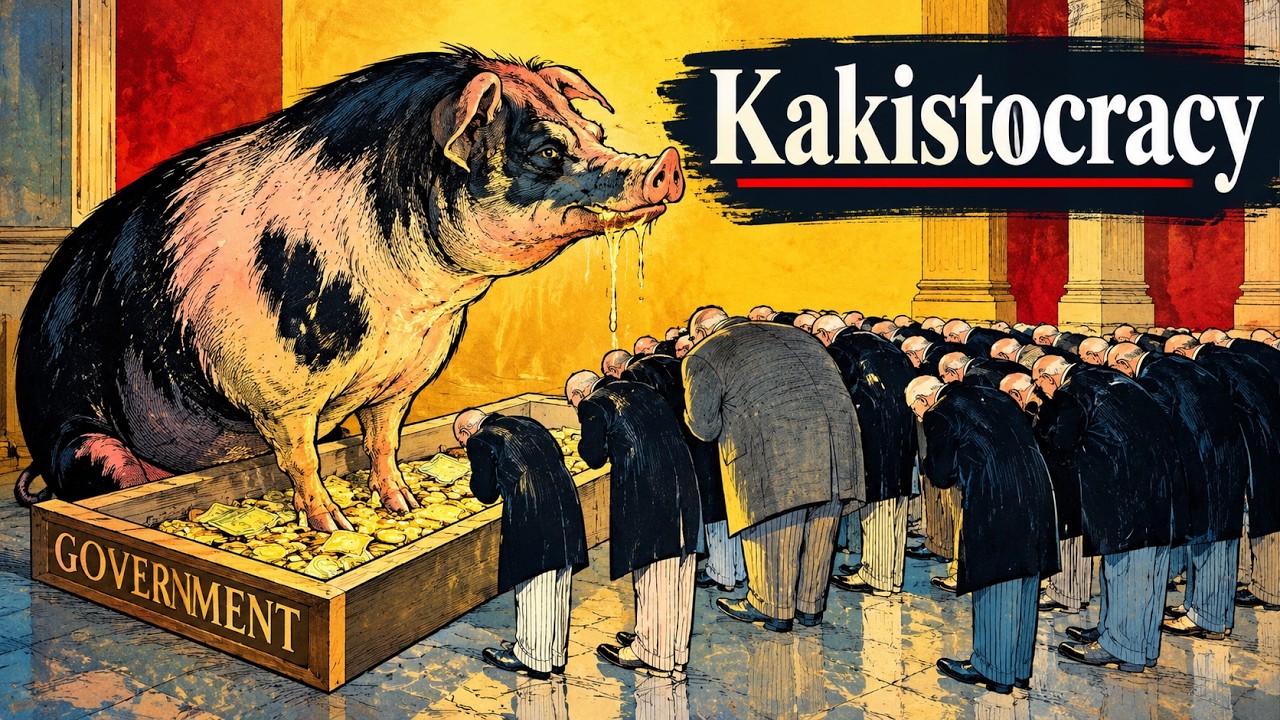
The narrator argues that modern governments have degenerated into kakistocracies, rule by the worst, where corrupt and power-hungry individuals dominate the highest levels of government and use political power to enrich themselves rather than serve the public. The narrator explains that the state’s inherent structure, which divides society into rulers and ruled and grants special powers to those in authority, attracts manipulative and ruthless individuals who outcompete principled people in the struggle for power, and over time these kakistocrats reshape institutions to protect their privileges while forming alliances with wealthy collabortakers who use lobbying and central bank monetary expansion to extract wealth from ordinary citizens. The narrator concludes that when the judiciary is co-opted and laws protect the corrupt rather than the honest, society is doomed, as Ayn Rand warned in Atlas Shrugged.
Top 5 Key Topics
The nature of kakistocracy: The narrator defines kakistocracy as rule by the worst, derived from the Greek words kakistos (worst) and kratos (power). In a kakistocracy, the highest levels of government are populated by corrupt, dishonest, power-hungry, manipulative, and sometimes sociopathic individuals who use political power to advance their own interests and enrich themselves and their cronies while the average citizen is impoverished and society deteriorates.
Why the worst get on top: The narrator explains that the state divides society into rulers and ruled and grants those who rule powers and privileges unavailable to ordinary citizens, attracting not only those motivated by public service but also those seeking wealth, power, and control. Friedrich Hayek observed in The Road to Serfdom that {{the readiness to do bad things becomes a path to promotion and power}} and {{the unscrupulous and uninhibited are likely to be more successful}}, giving manipulative and ruthless individuals an advantage in the struggle for political power.
Jobbery and collabortakers: The narrator describes how kakistocrats engage in jobbery, the exploitation of public office for private gain, receiving modest official salaries yet becoming extraordinarily wealthy through immoral and criminal dealings behind the scenes. They form alliances with collabortakers, wealthy individuals and institutions in the private sector who spend billions of dollars each year on lobbying to buy access to kakistocrats, using campaign contributions, political favors, gifts, and promises of lucrative post-office employment to shape laws, regulations, and economic policy in their favor.
Central banks as tools of theft: The narrator argues that central banks are among the most powerful tools of a kakistocracy because their ability to expand the money supply finances government spending and debt on a scale impossible through taxation alone, allowing kakistocrats to access vast sums without directly raising taxes. Murray Rothbard explained that monetary inflation acts as a hidden tax by which early receivers of newly created money expropriate wealth from late receivers, enriching the kakistocracy while transferring purchasing power away from ordinary citizens whose wages and savings buy less as prices rise.
Corruption of the judiciary: The narrator contends that in Western democracies the judiciary was established to serve as an independent check on political power, but in a kakistocracy it has been absorbed into the corrupt system it was meant to restrain. William Kovacs writes that individuals are appointed or denied appointment to courts based on political belief and affiliation, and under the present legal structure kakistocrats have laws that protect them from the people, allowing them to enact policies that protect their privileges and advance their selfish interests.