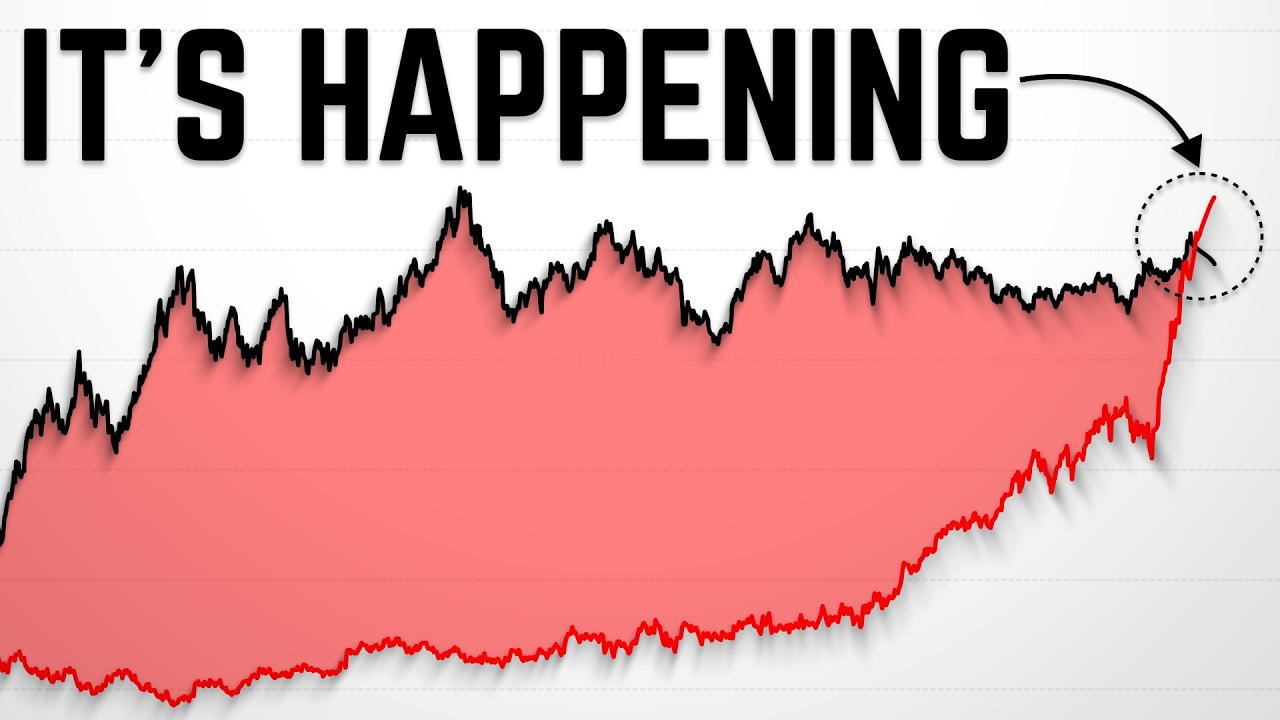
The speaker argues that America’s bond market is breaking because the US government and Big Tech are locked in an unprecedented battle for capital, with the government needing to borrow $2 trillion by 2027 and hyperscalers planning to borrow $420 billion for AI infrastructure. He presents data showing that Big Tech’s borrowing surged from under $50 billion between 2008 and 2024 to $194 billion in the first nine months of 2026, a 20-fold increase relative to government borrowing needs. The speaker concludes that the Federal Reserve will likely respond with financial repression and currency debasement, capping yields to bail out both borrowers while the US dollar loses purchasing power, mirroring the 1940s when the dollar lost 50% of its value and stocks rose 200%.
Top 5 Key Topics
Bond yields at crisis levels: The speaker notes that the 2-year borrowing cost hit 4.9%, the highest since the 2022 oil shock, the 10-year reached 5.25%, the highest since the 2007 financial crisis, and the 30-year hit 5.5%, the highest since the 2001 dot-com crash. He emphasizes that three different borrowing costs are simultaneously at levels last seen during major crises.
Government debt acceleration: The speaker reports that US national debt reached $40 trillion, with the government adding $1 trillion in new debt in just the last five months, a pace that once took 200 years. He states that the war in the Middle East has cost over $100 billion and adds roughly $100 million per day, with the government needing to borrow at least $2 trillion more by the end of 2027.
Big Tech borrowing surge: The speaker shows that hyperscalers kept borrowing between zero and $50 billion from 2008 to 2024, but doubled to $108 billion in 2025 and doubled again to $194 billion in the first nine months of 2026. He notes they plan to borrow another $420 billion by the end of 2027, going after over 20% of the government’s borrowing needs after borrowing less than 1% just a couple of years ago.
Debt death spiral risk: The speaker warns that interest payments on US government debt have surged from 1.5% to 3.5% of GDP, already exceeding the entire defense budget as a share of GDP. He explains that if rates rise just one more percentage point, interest payments could approach 5% of GDP, the danger zone where a debt death spiral becomes a real risk according to the Congressional Budget Office.
Financial repression playbook: The speaker draws parallels to the 1940s when the Federal Reserve capped short-term rates at 0.375% and long-term rates at 2.5% by printing money to buy government bonds. He notes that during that period the US dollar lost 50% of its purchasing power, food prices doubled, home prices climbed from $3,000 to $7,500, and stocks rose nearly 200% in what he calls a reverse stock market crash.