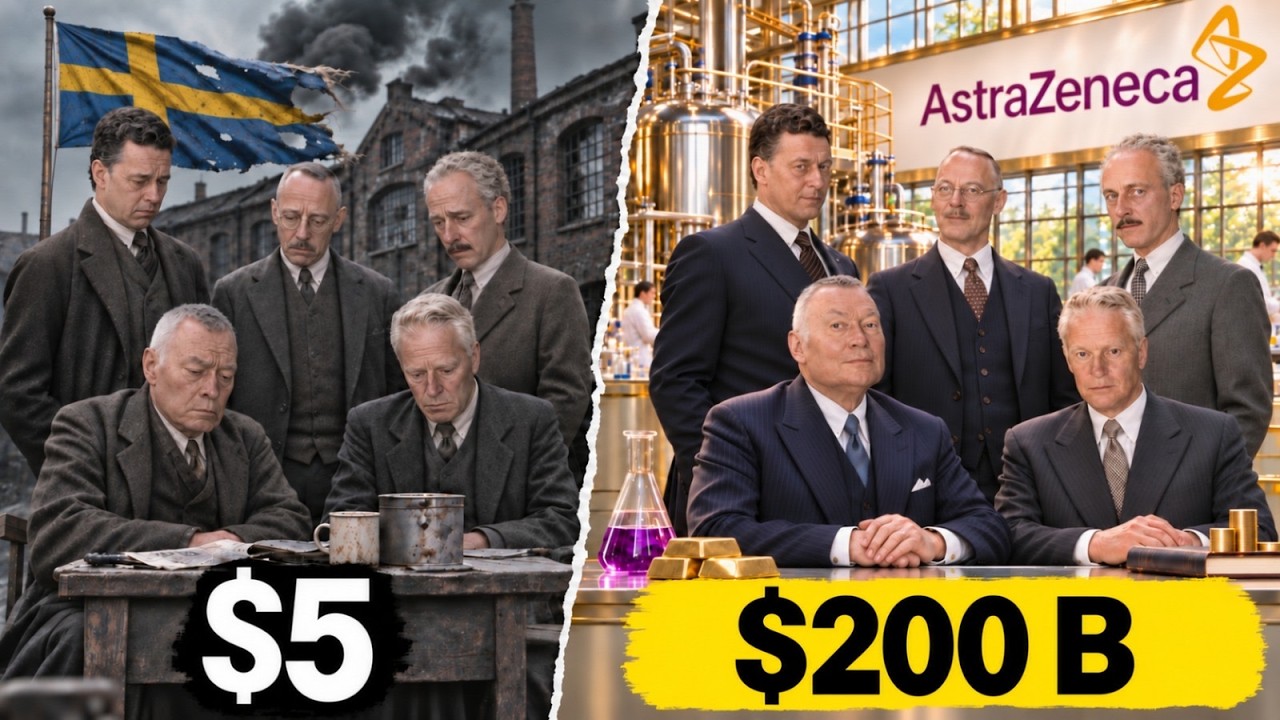
The narrator explains how the Wallenberg family acquired the Swedish pharmaceutical company Astra in 1924 for one krona (roughly $5 today) by taking on its 1 million krona debt (nearly $5 million in today’s dollars), a debt partly owed to their own banking interests, and turned it into AstraZeneca, now worth over $200 billion. The family built a business model around using their bank, Stockholm’s Enskilda Bank (founded 1856), to finance struggling companies and then take them over when they could not repay loans, separating industrial holdings into Investor AB in 1916 to comply with new Swedish legislation. The Wallenbergs’ patient capital and multi-generational strategy, combined with wartime demand boosts and the 1999 merger with British firm Zeneca (creating a $67 billion deal), allowed them to build a European industrial empire spanning pharmaceuticals, defense, manufacturing and banking that operates through ownership stakes, board positions and a feedback loop where profits fund research foundations and new investments.
Top 5 Key Topics
The one krona Astra acquisition: In 1924, Jacob Wallenberg and a private consortium bought the debt-ridden pharmaceutical company Astra from the Swedish government for one krona (less than $5 today), taking on debts of 1 million Swedish kronor (almost $5 million in current dollars), much of which was already owed to Wallenberg-linked interests. The deal gave them a foothold in pharmaceuticals and control of a company whose obligations partly ran back to their own financial circle.
Banking and industrial takeover model: The Wallenbergs established Stockholm’s Enskilda Bank in 1856 to finance Sweden’s emerging limited liability companies, and when borrowers could not repay, the bank took over rather than forcing bankruptcy, becoming major stakeholders in many firms during the 1896 downturn. In 1916, they created Investor AB to hold industrial shares separately from banking operations after new Swedish legislation restricted banks from long-term industrial ownership.
Wartime profits and post-war expansion: Astra’s original parent company, Svensk, borrowed heavily from Wallenberg’s bank to expand production of wartime products like artificial sweeteners and aspirin, but when post-war trade recovered and shortages disappeared, the company faced bankruptcy and the Swedish government took control before selling to the Wallenbergs. During World War II, Astra again benefited from disrupted imports and surging domestic demand, using profits and Wallenberg financing to expand into Denmark, Argentina and the United States.
The AstraZeneca merger and Pfizer rejection: In 1999, Astra merged with British pharmaceutical company Zeneca in a $67 billion deal, creating AstraZeneca with $14 billion in annual sales (the world’s fourth largest drugmaker), combining blockbuster drugs like Zestril and Prilosec. In 2014, AstraZeneca’s leadership rejected a roughly $100 billion takeover bid from Pfizer, keeping the company independent and positioning it to develop the first deployed COVID-19 vaccine (2 billion doses in over 170 countries) and reach $8.2 billion in operating profit by 2023.
Generational wealth through patient capital: The Wallenberg family’s investment network (Investor AB, Patricia Industries, Wallenberg Investments, and FAM) spans five generations and creates a feedback loop where AstraZeneca’s returns fund research foundations and new investments, including millions of dollars in antibody-based medicines that could generate billions in annual sales. The narrator argues the family thinks in generational terms rather than fiscal quarters, acquiring existing infrastructure (factories, licenses, distribution networks) from distressed companies for nominal sums rather than building from scratch.