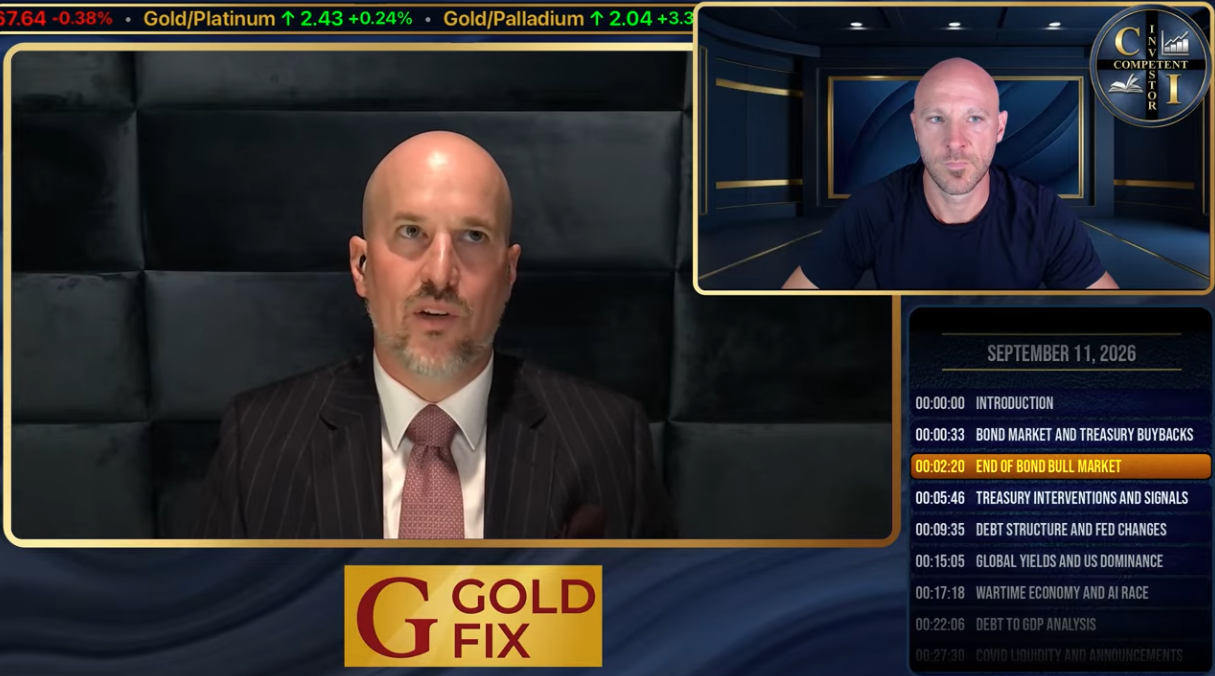
Summers argues the 1982-2022 bond super cycle is over — a tectonic shift — but that Bessent’s escalation of Treasury buybacks from $2 billion to $4 billion to $6 billion per operation is verbal intervention rather than a bazooka, since the Fed was buying $40 billion a month not long ago and the Treasury market trades trillions. He repeatedly refuses to make confident crisis calls, noting the US remains the superpower whose economy is bigger than the second, third and fourth largest combined, that Japan runs 200% debt-to-GDP with its central bank owning over half the debt and the lights are still on, and that the “bulldozer” Trump administration keeps plowing through consensus predictions that never pan out — oil is over $100 and diesel at all-time highs, yet stocks are near record highs with corporate profits reportedly growing 50% year-over-year. His working framework is that everything from Treasury verbal intervention to $5,000 checks and Trump accounts is aimed at keeping stocks up and bonds calm for 60 days until the midterms, with the president even admitting the war is “on hold till after the midterms.”
Top 5 Key Topics
Buybacks as signal, not bazooka: Summers says the Treasury is entering the bond market as an ordinary participant — not printing like QE — and $6 billion per auction is small relative to a market trading hundreds of billions. He suspects the Fed under Warsh isn’t ready to move fast enough, so Treasury is stepping in verbally in the meantime, citing Volcker’s rule via Ron Paul that officials tolerate sell-offs as long as they’re orderly.
Warsh dismantling Fed culture: Warsh cut the first Fed statement by roughly 90%, from a page and a half to two paragraphs, dropped the dot plot, and publicly acknowledged US data is garbage — response rates around 10%, and shelter, the single biggest inflation component, measured by asking homeowners what they think they could rent for. Summers says if Fed officials were physicians “there’d be malpractice suits left and right,” and that changing institutional inertia handcuffs the Fed in the meantime.
Wartime economy and the AI arms race: The US is running a wartime playbook — direct stakes in critical minerals, drone companies, AI firms, Trump personally pumping Intel — which Summers says is national security steering, not grift. Bessent argues the AI buildout cannot slow or China wins and “nothing else matters,” and Summers wonders aloud how much of the bond move is simply the two largest economies throwing everything at a technological arms race.
Debt past 100% of GDP and what actually predicts trouble: Summers won’t call $40 trillion or 100% of GDP a crisis trigger, citing Greece at 120% (which couldn’t print euros) versus Japan at 200% (which nationalized its financial system), and invokes Druckenmiller — roughly 30% annually for 30 years — who never let debt levels drive investing absent a clear bond market signal. He directs listeners to high yield credit and HYG as the canary, since junk traders are more attuned to macro risk and credit often turns a day before the S&P.
Trump can move oil with a sentence: Summers calls it the big wakeup call for macro traders this year — oil drops 5% in futures whenever Trump says a deal is around the corner, “round 38 at this point,” and the market keeps falling for it. He adds nobody knows the real state of the oil market, noting the Strait of Hormuz was never physically closed but insurers refused to cover tankers, some mines turned out to be inflated trash bags, and a secondary trench route was reportedly dug.