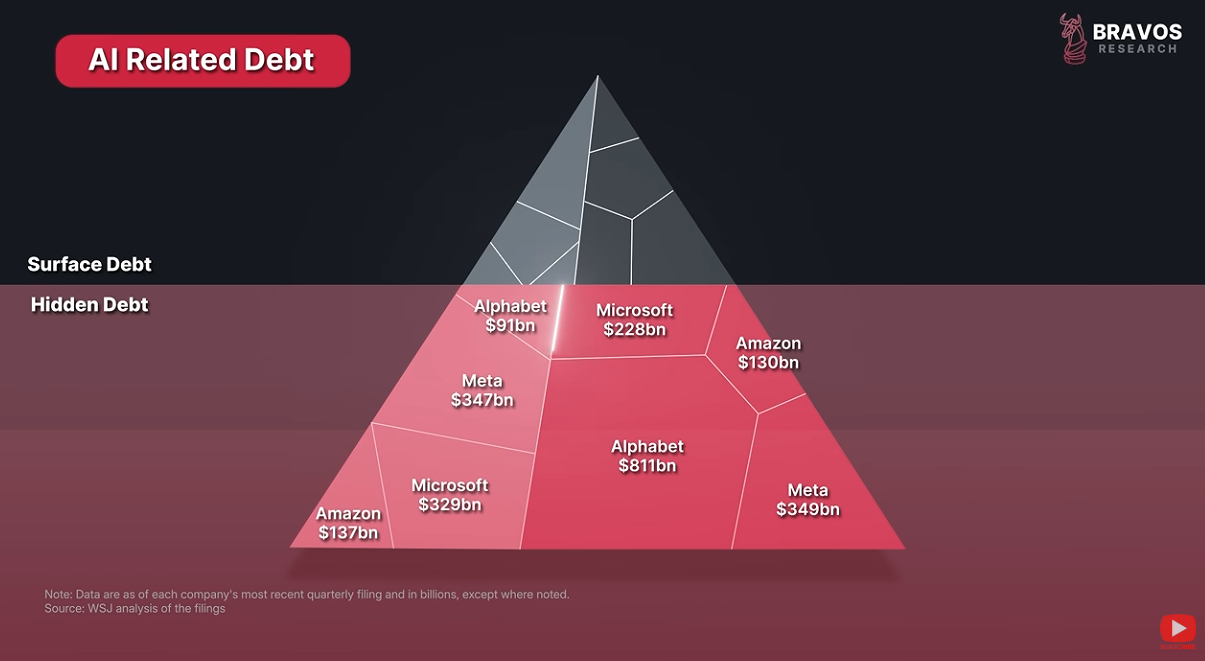
The speaker argues that roughly $500 billion in big tech AI debt is only the visible portion, and that committed AI purchases and leases across Alphabet, Meta, Microsoft, Amazon, and Oracle total nearly $3 trillion, about 10% of US GDP, exceeding the dot-com telecom debt of $300 billion and the $1.3 trillion subprime market combined. Credit default swaps on Oracle have surged to their highest level since 2009, with credit risk also rising at Alphabet, Amazon, Meta, Microsoft, and Nvidia, and the speaker stresses that credit markets historically signal trouble six months to a year before stocks and the real economy. The core fragility is a financing loop in which the entire $2 trillion AI buildout rests on OpenAI and Anthropic, two cash-burning companies with roughly $100 billion in combined sales, which he compares to balancing an elephant on a ball on a tightrope.
Top 5 Key Topics
The $3 trillion AI debt stack: Committed AI purchases and leases across the major hyperscalers approach $3 trillion, roughly 10% of US GDP, dwarfing the roughly $300 billion of dot-com telecom debt and the $1.3 trillion subprime mortgage market that broke the global economy in 2008.
Credit markets lead, stocks follow: Oracle CDS pricing is now above its global financial crisis levels, and the speaker notes the housing-bubble warning appeared in July 2007, six months before stocks fell roughly 60%, while the dot-com credit warning came in early 2000, months before the market fell and over a year before recession. Lenders react first because their upside is capped while equity investors chase unlimited upside and disregard risk.
The circular financing loop: OpenAI and Anthropic need investor capital to pay the hyperscalers, the hyperscalers need debt to build the infrastructure, and the hyperscalers need AI-lab demand to service that debt. The speaker cites Anthropic going from $1 billion to $74 billion in revenue since 2024 and OpenAI from $2 billion to $41 billion, with a combined valuation near $2 trillion and a recent $122 billion OpenAI funding round.
Adoption is real but early: US firm adoption of AI went from 2% in 2018 to 6% today, and household paid subscriptions from virtually zero in 2023 to 2.2%, a pace the speaker says matches electricity and the internet. Investors are underwriting what these companies earn in five to ten years, not today.
Liquidity is the trigger, not debt itself: The speaker argues debt only becomes dangerous when liquidity disappears, as in 2001 when Fed tightening popped the bubble, and says investors should watch whether OpenAI and Anthropic keep raising at rising valuations and whether the Fed keeps money loose. He warns that passive buy-and-hold stops working in this regime, while also cautioning against trying to time the market.