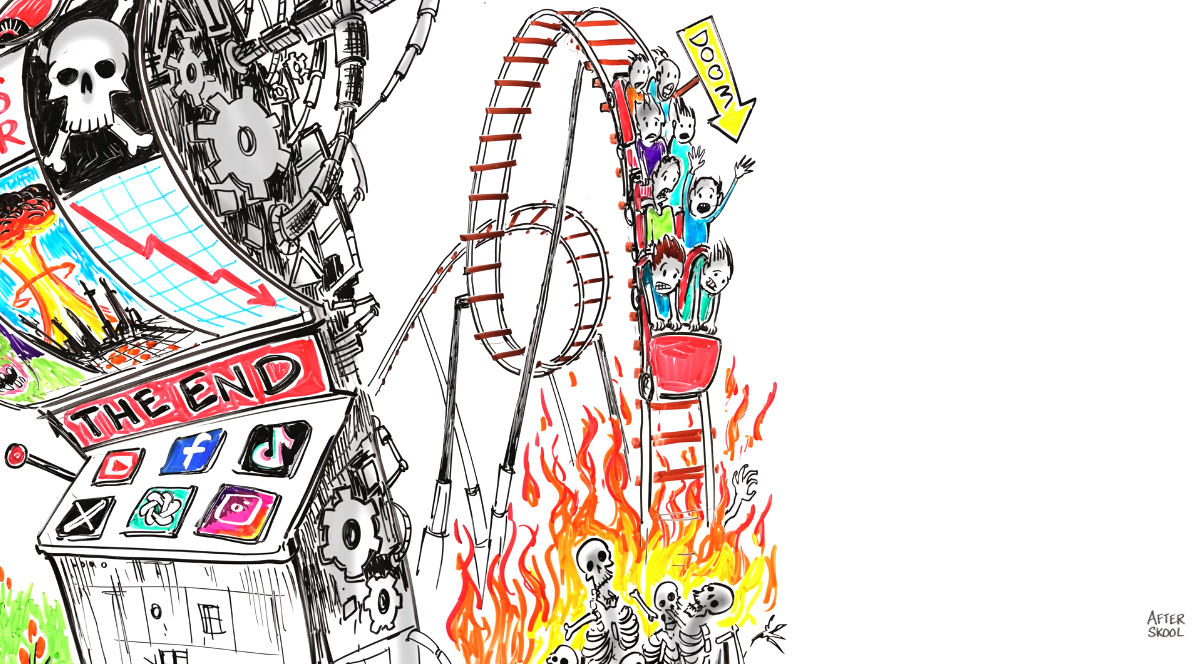
John argues that our current sense of living in “unprecedented” end times is an illusion, and that history should be understood as an ever-turning wheel where collapse is really transformation, citing the late Bronze Age collapse (~1200 BC, drought/famine plus the mysterious Sea Peoples), the centuries-long dissolution of Rome, and the “dark ages” that actually produced lowercase letters, the Carolingian Renaissance under Charlemagne, and the Islamic Golden Age at Baghdad’s House of Wisdom. He contends that today’s panics over AI, climate, WWII, and declining birth rates all have direct historical precedents, pointing to the Greek historian Polybius describing population decline in the 2nd century BC and the Black Death breaking feudalism by making surviving peasants economically valuable. His core conclusion is that apocalyptic anxiety is a permanent feature of “human software” rather than reality, and that recognizing this should make people active rather than passive: the world has survived 100% of its predicted apocalypses, so we must stay and build a better future.
Top 5 Key Topics
The wheel of history vs. the straight line to a cliff: John reframes collapse not as a light switch but as a wheel rotating downward, arguing that standing on a descending spoke genuinely feels like the end of the world even though it is a recurring cycle. He applies this directly to modern claims that America or Western civilization is the “new fall of Rome.”
The late Bronze Age collapse as proof of recovery: Around 3200 years ago, massive established empires vanished in a perfect storm of drought, famine, economic failure, and invasion by the Sea Peoples. Yet out of that darkness came the Iron Age, classical Greece, and the foundations of the modern world.
The “dark ages” were productive, not dark: John claims the era was only labeled dark due to a lack of surviving paperwork, and that dark-age monks invented lowercase letters, spaces between words, and legible writing still used today. He cites the Carolingian Renaissance under Charlemagne (8th–9th centuries) as a literary and artistic revival 600 years before Da Vinci.
Declining birth rates as a historical rerun: John quotes Polybius describing low birth rates and depopulation in 2nd-century BC Greece, blaming “pretentiousness, avarice, and indolence,” and argues the real driver then and now is that children are expensive in wealthy urban societies. He frames population decline as often preceding a “golden age of the individual.”
The narcissism of imagining you’ll witness the end: John argues every generation wants to be history’s main character, citing the year 1000 AD apocalypse panic (people abandoning farms and fleeing to mountains) and the Aztecs smashing their pottery every 52 years awaiting the dawn. In both cases the sun rose and everyone awkwardly went back to work.