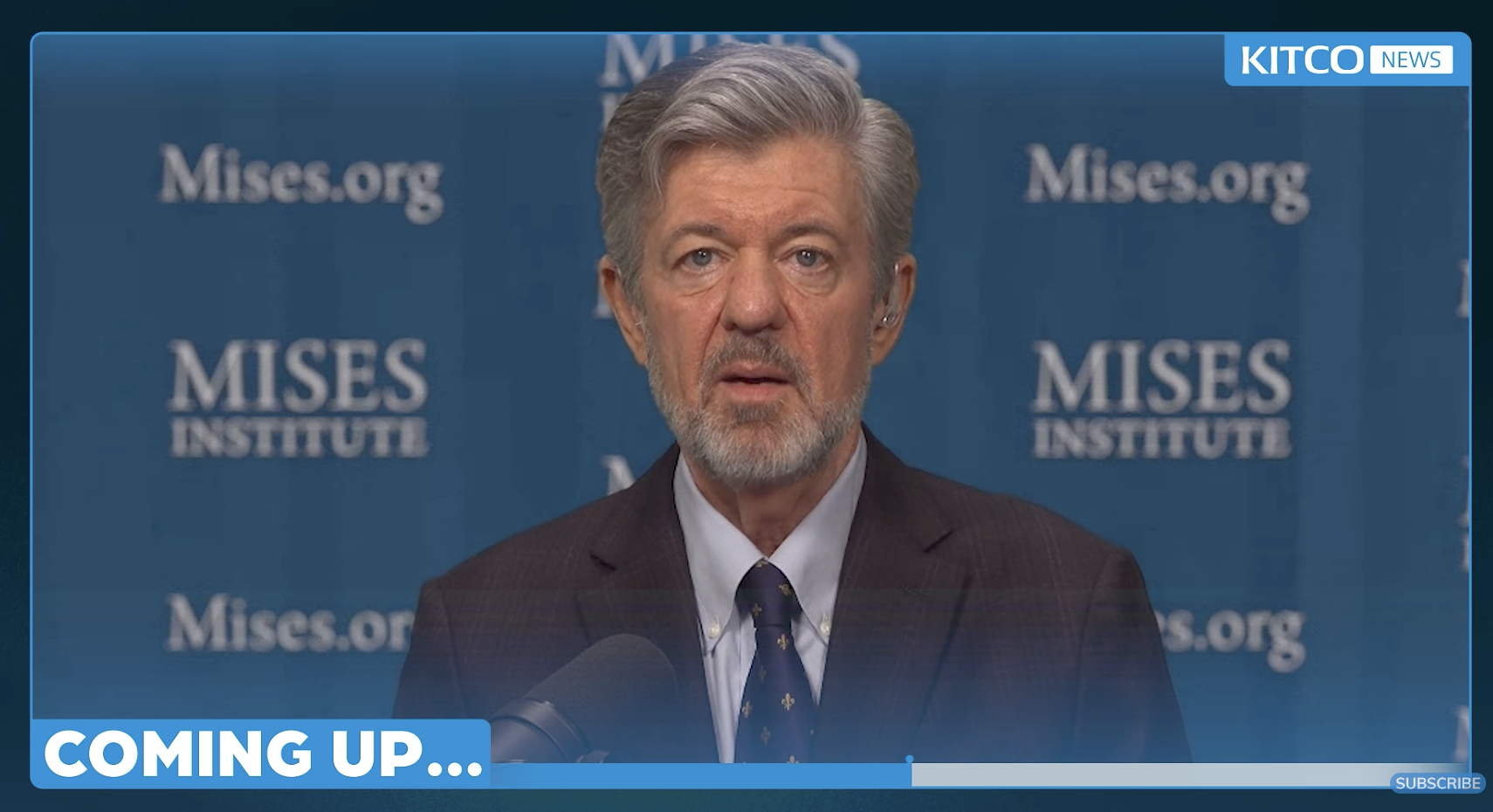
Mark Thornton of the Mises Institute, author of The Skyscraper Curse, argues that the Fed’s first rate hike in three years, which Chairman Kevin Warsh described as removing “a dose of accommodation,” is not real tightening, since it leaves rates only about a tenth of a point above 3.8% inflation. He says the $725 billion in hyperscaler AI capex and more than $350 billion in AI bond issuance this year have the same signature as past “technobubbles,” and he expects the stranded-asset costs to land unfairly on taxpayers and utility customers. Thornton calls central banking a Marxist “socialist bureaucracy” that should not exist in any form, blames government choke points (like the undefended Saudi East-West pipeline) for systemic fragility, and argues that only a return to a gold standard will force governments to shrink their debt and their foreign wars.
Top 5 Key Topics
The Fed’s own SVB post-mortem: A new Fed report found supervisors knew or should have known about Silicon Valley Bank’s problems a year before it failed, and staff believed doing nothing was personally safer than acting. Thornton says the supervisors stayed quiet because sounding the alarm would have meant admitting the Fed’s zero-rate policy, which pushed banks to load up on government bonds, caused the losses.
Hikes that aren’t tightening: Bank of America’s rates team says the Fed could go back above 5%, possibly to 5.5%, and CME FedWatch odds of an October 28 hike jumped from 7% to 58% in a month. Thornton agrees with Warsh that policy is not restrictive and warns that accelerating inflation will push up mortgages, business financing, and the government’s own interest bill.
Skyscraper curse and AI data centers: Thornton says record-breaking towers have signaled the start of economic crises for 150 years, and that the Jeddah Tower is likely to fall short of its record height as the Saudi situation deteriorates (his sources there have gone silent). He calls AI data centers this cycle’s skyscrapers, pointing to hyperscaler bond issuance that went from under $30 billion a year to $120-140 billion last year and over $350 billion so far this year, including 30- and 100-year bonds financing assets that last about three years.
Energy shocks and the Saudi pipeline: August factory output fell 0.3% while utility output rose 1.8%, and Saudi Aramco told European customers they will receive no crude next month after drones hit the East-West pipeline, which carries 2.6-4 million barrels a day. Thornton calls the pipeline a “sitting duck” the Houthis or Iran could hit again at any point or at its pumping stations, and cites diesel and jet fuel shortages (a factor in Spirit Airlines shutting down) as proof that government intervention creates the economy’s breaking points.
Gold and the central bank shift: Citing Ronnie Stoeferle’s data, Poland and China have been among the biggest gold buyers since 2022 while no G7 country makes the top 10, which Thornton explains by calling the G7, including the US, “run by socialist governments.” He praises Poland’s Austrian-economics movement and its expanding silver mining (the largest in Europe), and says honest money would kill central banks and make both government debt and military adventures untenable.